
Free love and social reform
“Make love, not war” offered a memorable refusal of authority. But a slogan cannot explain how a contraceptive ban falls, a profession changes its rules, or a woman gains more control over her life. In the United States, the free-love counterculture helped make sexual conventions open to challenge. Feminist and gay-liberation movements then argued over what freedom required—and often criticized the counterculture’s own inequalities.[1][8]
This article focuses on the United States and follows consequences into the early 1970s. “Free love,” the sexual revolution, women’s liberation, and gay liberation overlapped, but they were not interchangeable movements. Treating them as one makes it too easy to credit a cultural mood for changes won through specific campaigns.[1][7][8]
An older idea in a new setting
Free love predates the 1960s. Nineteenth-century advocates challenged the legal restraints surrounding intimate relationships; the term did not simply mean indiscriminate sex. PBS’s historical account traces later connections through bohemian and Beat cultures and describes the renewed prominence of sexual radicalism amid antiwar politics and youth culture in the sixties.[1]
That challenge was also entangled with commerce. PBS’s history of the Pill describes a growing singles culture promoted through magazines and books, including Playboy and Sex and the Single Girl. Sexual nonconformity could be a political position, a private choice, or a marketable lifestyle. Those possibilities did not necessarily deliver the same kind of independence.[2]
Contraception: permission had material consequences
The Pill’s arrival was not a switch that automatically produced sexual liberation. Goldin and Katz note that it received FDA approval in 1960, but access spread among young unmarried women later, as state legal changes made it easier to obtain. PBS likewise cautions against treating the medication as the sole cause of the sexual revolution. Technology, law, and changing expectations interacted.[2][6]
The legal sequence makes that interaction visible. Griswold v. Connecticut in 1965 struck down a contraceptive-use ban as applied to married couples. Eisenstadt v. Baird in 1972 invalidated unequal treatment of unmarried people in access to contraception. Its reasoning located the decision whether to bear or beget a child with the individual, rather than treating marriage as the source of every protection.[4][5]
These cases were concrete disputes, not court endorsements of a whole counterculture. Eisenstadt arose after William Baird gave contraceptive foam to a woman following a lecture. That detail matters: an abstract argument about sexual freedom became actionable through a person’s prosecution, legal representation, and a challenge to how the state classified its citizens.[5]
There was an economic consequence beyond the bedroom. In their 2002 study, economists Claudia Goldin and Lawrence Katz linked earlier legal access to the Pill among young unmarried women with greater investment in lengthy professional education and later marriage. The study uses differences across states and cohorts; it does not measure a single “free love effect.” It offers evidence for one particular mechanism connecting reproductive control with career planning.[6]
Freedom for whom? The feminist challenge
Changing the rules about sex did not automatically change who performed housework, who cared for children, or whose wishes set the terms of a relationship. Carol Hanisch’s 1969 essay, later published as The Personal Is Political, defended women’s collective discussion of supposedly private problems as political work. Her later introduction explicitly connects that approach with childcare and the division of domestic labor.[3]
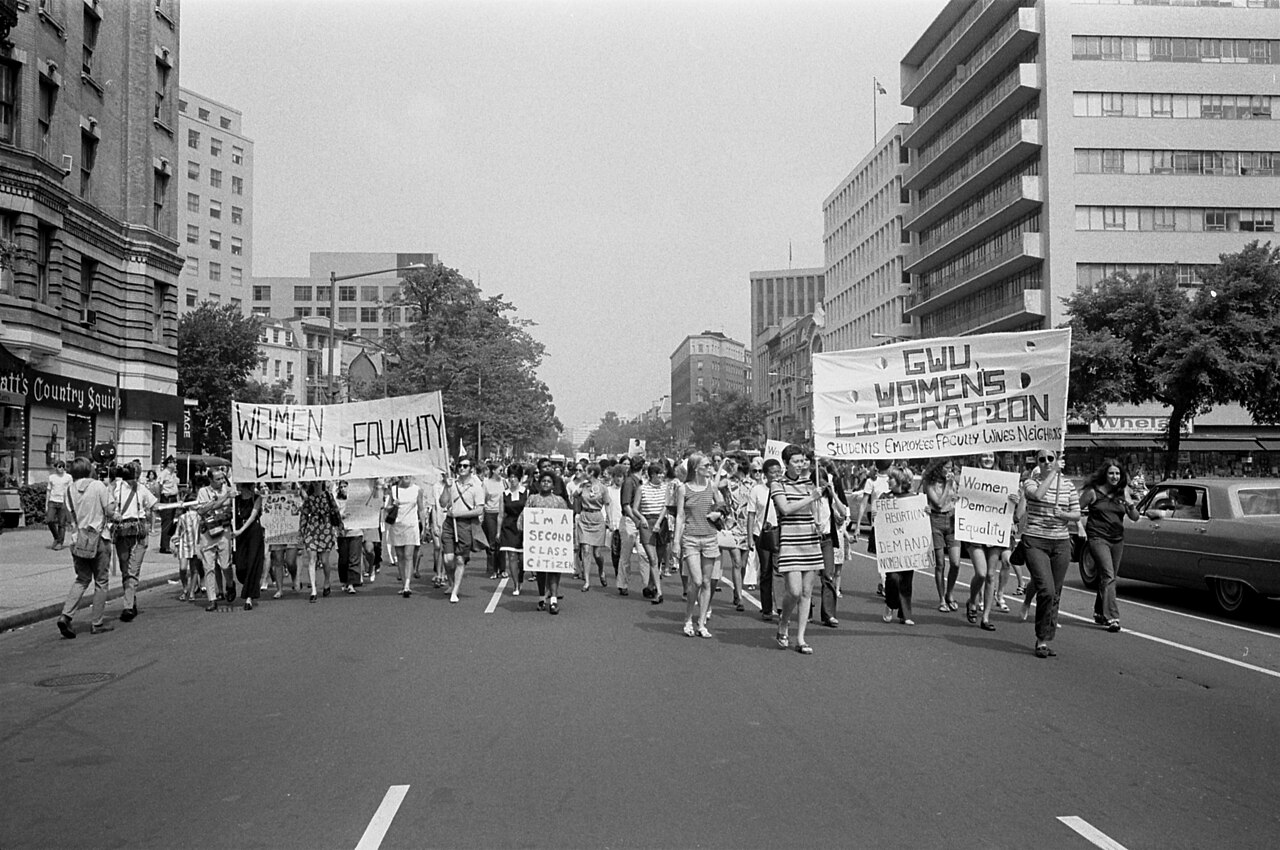
This helps explain why women’s liberation could develop partly through criticism of the New Left’s sexual culture. As the PBS account describes, feminists challenged free love as it was practiced, not merely conservative restrictions. An offer of sexual openness could leave existing power relations intact. The analytical question becomes whether someone can make a choice on their own terms, including refusing, rather than whether a scene looks permissive.[1][3]
Nor was there one universal female experience. The National Women’s History Museum’s account describes Black feminists challenging the neglect of racial and economic inequality, and lesbians confronting exclusion within feminist organizations. A story that gives the counterculture all the credit would erase the people who had to argue that its promises were not being shared equally.[10]

Gay liberation made institutions answer
The National Park Service describes the Stonewall uprising of June 1969 as a catalyst for a more visible and assertive struggle, while stressing earlier organizing. Queer people did not first acquire political agency when heterosexual youth questioned monogamy. Resistance to police harassment and exclusion had its own history and its own demands.[7]
Elizabeth Sepper and Deborah Dinner’s research follows feminist and gay-liberation campaigns against exclusion in public places. Liquor regulation, business practices, and weak discrimination protections helped restrict who could socialize and express themselves. Activists pursued mutually reinforcing reforms. Freedom therefore concerned access to ordinary public life as well as what happened in private.[8]
The American Psychiatric Association’s 1973 decision to stop classifying homosexuality itself as a mental disorder provides another example of organized institutional pressure. The APA’s retrospective highlights activists Barbara Gittings and Frank Kameny alongside psychiatrist John Fryer, who appeared in disguise at its 1972 meeting. This was a targeted struggle involving activists and professionals, not an automatic consequence of more permissive dating.[9]
| Date | Change | What the distinction reveals |
|---|---|---|
| 1965 | Griswold protects marital contraceptive privacy. | A specific court ruling, initially framed around marriage. |
| 1969 | Stonewall helps catalyze a new phase of gay liberation. | Collective resistance builds on earlier organizing. |
| 1972 | Eisenstadt rejects unequal contraceptive access for unmarried people. | Individual freedom extends beyond marital status. |
| 1973 | Roe v. Wade recognizes constitutional protection for abortion, subject to a regulatory framework. | A major historical ruling; it was overturned by Dobbs in 2022. |
| 1973 | APA declassifies homosexuality itself as a mental disorder. | Professional rules can change through evidence, advocacy, and internal dissent. |
Culture opened an argument; organizing changed the terms
The table is a chronology, not proof that the free-love movement caused every event on it. Roe’s later reversal is also a reminder that social reform is contested and can be undone. A change in public attitudes and a durable legal protection are different outcomes; neither should be assumed from the other.[12][13]
The strongest interpretation is that free love helped widen the imaginable range of intimate lives, while reform movements fought over the conditions needed to live them. Access to contraception, fair treatment in public places, recognition by institutions, and control over domestic work required more than permission to reject convention. They required changes in who held power and who bore the costs.[3][6][8]
That is where culture and economics meet. An invitation to live differently is limited when education, income, care obligations, or institutional exclusion make the invitation hard to accept. The sixties helped put those tensions into public argument. Its legacy is best understood through the campaigns that made freedom more usable—and the criticisms that exposed how unevenly it was distributed.[3][6][8][10]
Sources & citations
- PBS American Experience, “Free Love” — Historical overview of nineteenth-century free love, bohemian culture, the sixties, and feminist criticism of the New Left.
- PBS American Experience, “The Pill and the Sexual Revolution” — Distinguishes the availability of a technology from a single-cause explanation of cultural change.
- Carol Hanisch, “The Personal Is Political” (1969; introduction 2006) — Primary activist text. The later introduction is distinguished here from the original essay, published in 1970.
- Griswold v. Connecticut, 381 U.S. 479 (1965) — Primary judicial opinion. Its holding concerned marital privacy, not unrestricted access for everyone.
- Eisenstadt v. Baird, 405 U.S. 438 (1972) — Primary judicial opinion on unequal contraceptive access for married and unmarried people.
- Claudia Goldin and Lawrence F. Katz, “The Power of the Pill” (2002) — Journal of Political Economy 110(4), 730–770. Research on access, professional education, and marriage timing; findings are not a causal estimate of free love itself.
- National Park Service, “Stonewall National Monument Cultural Landscape” — Describes the uprising as a catalyst while recognizing the movement’s earlier history.
- Elizabeth Sepper and Deborah Dinner, “Shared Histories” (2020) — University of Richmond Law Review 54, 759. Research on feminist and gay-liberation campaigns for freedom in public accommodations.
- Saul Levin, American Psychiatric Association, “CURED” retrospective (2021) — Institutional account of John Fryer, Barbara Gittings, Frank Kameny, and the campaign leading to the 1973 decision.
- Kerri Lee Alexander, National Women’s History Museum, “Feminism: The Second Wave” — Used for Black feminist and lesbian challenges to exclusion; legal holdings are checked against the court opinions above.
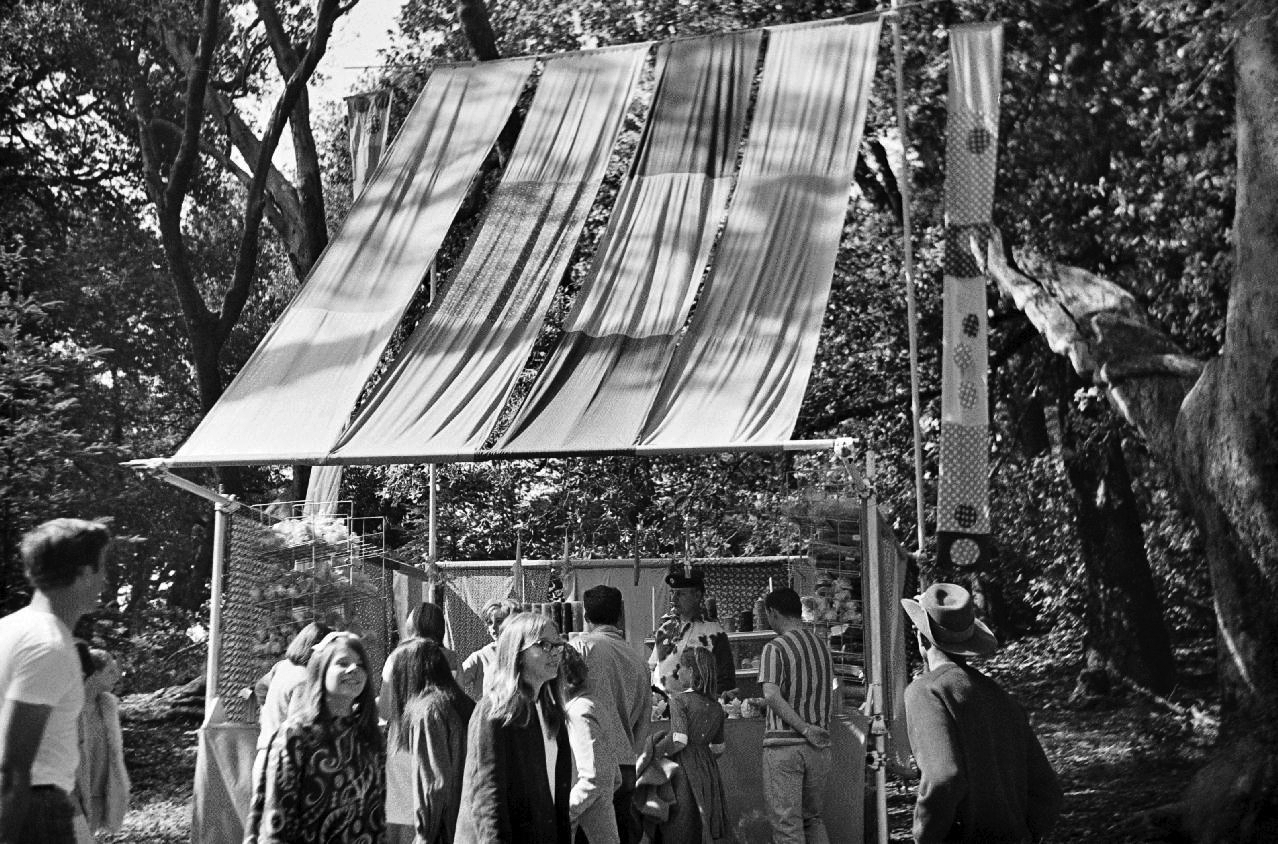
- Bryan Costales, KFRC Fantasy Fair candle booth, June 1967 — Featured image, CC BY-SA 3.0. Contextual festival photograph; no claim is made about the individuals’ beliefs or sexual behavior.
- Roe v. Wade, 410 U.S. 113 (1973) — Primary opinion, cited for its historical holding. Overturned in 2022; not presented as current law.
- Dobbs v. Jackson Women’s Health Organization (2022) — Primary Supreme Court opinion overturning Roe and Casey; included to avoid presenting Roe’s historical protection as still operative.
- Inline image: Warren K. Leffler — A women's liberation march from Farragut Square to Lafayette Park, Washington, D.C., August 26, 1970. Photograph by Warren K. Leffler, U.S. News & World Report collection, Library of Congress. Public domain; Commons version has a small edge crop.