
Medici money and the Reformation
There is a real connection between Medici wealth and the beginnings of the Protestant Reformation: Pope Leo X was Giovanni de’ Medici, a son of Lorenzo the Magnificent. But the connection becomes more revealing when we separate the family fortune, the papal treasury, and the bank financing an archbishop. They were not one account, and treating them as one hides how the controversy worked.[1][2][3]
From banking wealth to a papal dynasty
The Medici’s banking businesses helped turn economic resources into political influence in Florence. They also cultivated a valuable relationship with the papacy: managing papal finances brought business and proximity to power. Heinrich Lang’s account of the bank emphasizes that it was a network of partnerships, not simply a modern corporation with a familiar surname on the door.[1]
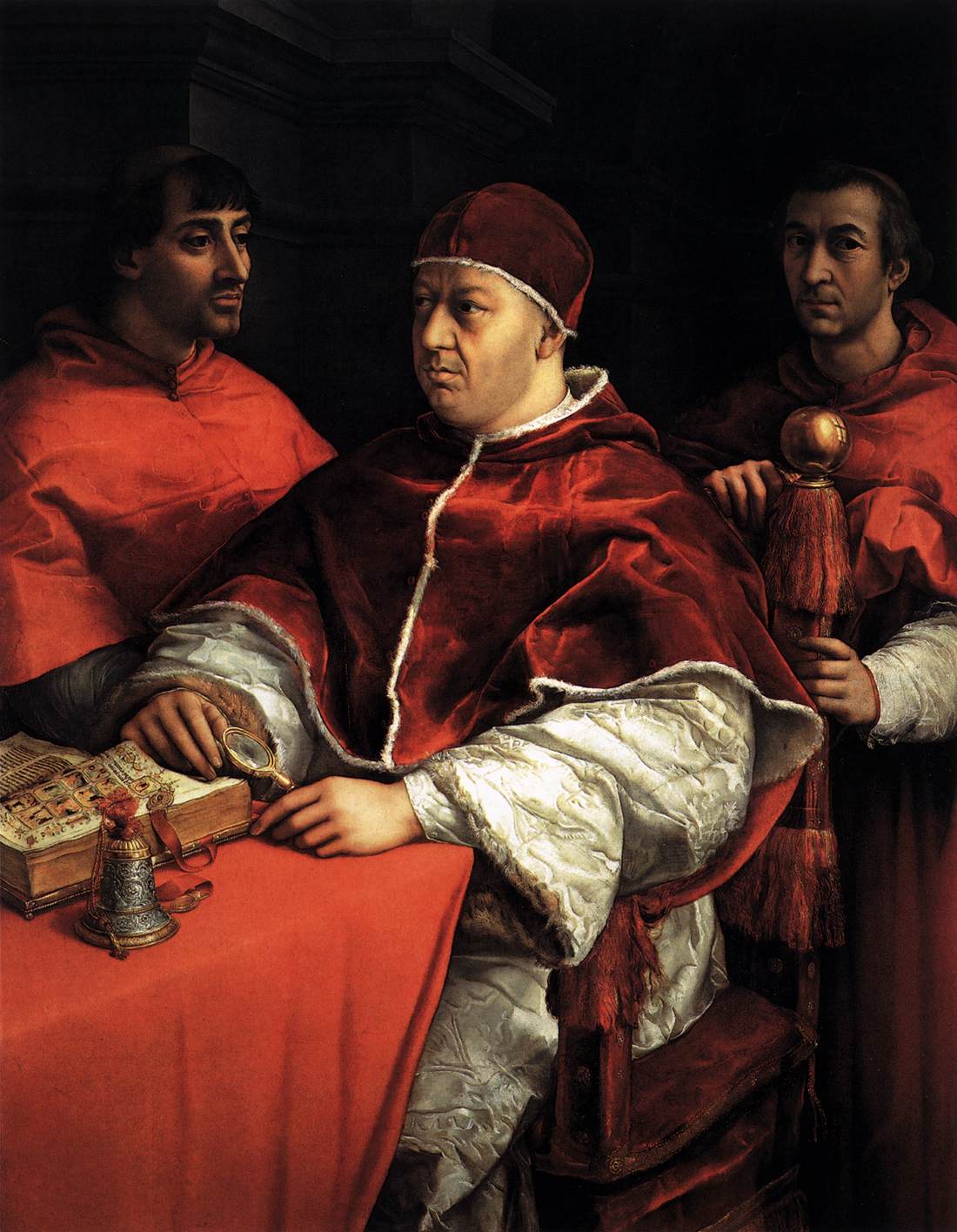
Giovanni’s career developed inside this powerful family. He became a cardinal in 1489 and pope in 1513. His later reputation for patronage belongs to a Renaissance court in which religious office, diplomacy, art, and dynastic ambition overlapped. Raphael’s portrait, reproduced above, places him with two cardinal relatives: an image of the family connections surrounding the office.[2][8]
The chronology prevents a common mistake. The old Medici banking partnerships were liquidated in 1494, well before Leo’s election and Luther’s 1517 intervention. The dynasty survived that business structure. Consequently, saying that “the Medici bank sold indulgences to start Protestantism” confuses a family’s longer political ascent with a later papal funding arrangement.[1][2]
What an indulgence was supposed to do
An indulgence was not, in Catholic doctrine, permission to sin in advance or a purchase of God’s forgiveness. The distinction was between guilt and the punishment remaining after forgiveness. The Church’s present Catechism describes indulgences in those terms; Oxford’s annotated edition of Luther explains the corresponding distinction in the penitential system he was criticizing. Keeping doctrine separate from sales claims makes the controversy more intelligible.[4][5]
Luther objected to assurances that money and indulgence letters could make a person secure before God. In the Ninety-five Theses, repentance, the limits of papal authority, and care for neighbors are intertwined. His challenge was theological, but it also asked what Christians should do with scarce resources when religious fundraising competed with other obligations.[5]
Follow the payments
Leo continued the rebuilding of St. Peter’s begun under Julius II. The papacy also faced the costs of court life, patronage, and politics. Meanwhile, Albert of Brandenburg wanted the archbishopric of Mainz while already holding other ecclesiastical offices. Fees and a dispensation created a large financial obligation; the Fugger banking house advanced the money.[2][3]
The arrangement joined those needs. Revenue from the authorized indulgence campaign was to be divided: half toward Albert’s debt to the Fuggers, half to Rome for St. Peter’s. Johann Tetzel’s preaching became a focus of Luther’s protest in 1517. The banker in this particular chain was Fugger, while the pope authorizing it was a Medici.[2][3]
| Participant | Role in the arrangement |
|---|---|
| Leo X and the papacy | Authorized the indulgence campaign associated with financing St. Peter’s. |
| Albert of Brandenburg | Owed money connected with obtaining Mainz and holding multiple offices. |
| The Fugger banking house | Advanced the funds; Albert’s share of campaign receipts serviced his debt. |
| Preachers and contributors | Campaign preaching solicited contributions; receipts linked religious promises with institutional finance. |
| Luther | Challenged the preaching and the priorities that redirected believers’ money. |
A dispute about who should pay
Thesis 86 asks why an immensely wealthy pope should build St. Peter’s using the money of poor believers rather than his own. That is an accusation within an argument, not an audited statement of Leo’s personal net worth. Read alongside the institutional debts, it exposes a problem of legitimacy: how could visible magnificence justify further demands on people with much less?[3][5]
The resulting conflict did not remain an internal accounting complaint. Print made short polemical texts reproducible and distributable. The Morgan Library’s exhibition describes a pamphlet war involving Luther and his opponents; historian Mark U. Edwards Jr. analyzes how this publishing struggle shaped the early Reformation. A controversy over spiritual authority could acquire readers far beyond the places where the money was collected.[6][7]
By 1520, Leo’s bull Exsurge Domine condemned propositions associated with Luther; excommunication followed in January 1521. The break therefore unfolded through confrontation and widening disagreement. The indulgence dispute explains a central ignition point in the Lutheran Reformation, rather than providing a complete origin story for every later Protestant tradition.[3][6]

Wealth mattered because authority depended on it
The useful economic reading is not that money made religious conviction unreal. Belief made indulgences meaningful, while institutions organized the flows of revenue around them. Banking, architectural patronage, family advancement, and arguments about salvation met in the same system. Luther’s protest challenged both particular teachings and the credibility of authorities whose financial priorities those teachings appeared to serve.[1][4][5]
The Medici connection is thus both direct and indirect: direct in the identity of Leo X, indirect in the family’s earlier conversion of commercial wealth into political and ecclesiastical standing. Credit supplied by another bank then helped turn that world’s financial pressures into a crisis of religious trust. That is a more precise connection than either “the Medici caused Protestantism” or a story in which money is merely decorative background.[1][2][3]
Sources & citations
- Heinrich Lang, “Medici Bank,” Oxford Bibliographies (2022) — Accessible introduction: banking partnerships, papal business, political power, and liquidation in 1494.
- Concordia Seminary, Reformation 500: “Pope Leo X” — Scholarly Lutheran institutional account of Giovanni de’ Medici’s career, patronage, and the indulgence controversy; compared here with a Catholic reference account.
- “Leo X, Pope,” New Catholic Encyclopedia — Sections on the St. Peter’s indulgence and Luther: Albert’s borrowing, the division of receipts, and the 1520–1521 condemnation.
- Catechism of the Catholic Church, paragraphs 1471–1473 — Modern official explanation of the distinction between forgiveness and temporal punishment; not a transcript of Tetzel’s preaching.
- Martin Luther, Ninety-five Theses (1517), Oxford Taylor Editions — Primary text in annotated English translation, especially theses 21, 27–28, 36, 43–46, 50, and 86. Luther’s rhetorical claims are not financial accounts.
- The Morgan Library & Museum, “Media War” — Exhibition account of the pamphlet controversy and the road to the Diet of Worms.
- Mark U. Edwards Jr., Printing, Propaganda, and Martin Luther (1994) — University of California Press; study of print and the early Reformation.
- Raphael, Portrait of Pope Leo X and two cardinals: image record — 1518–1519; public domain. Identifies Giulio de’ Medici and Luigi de’ Rossi.
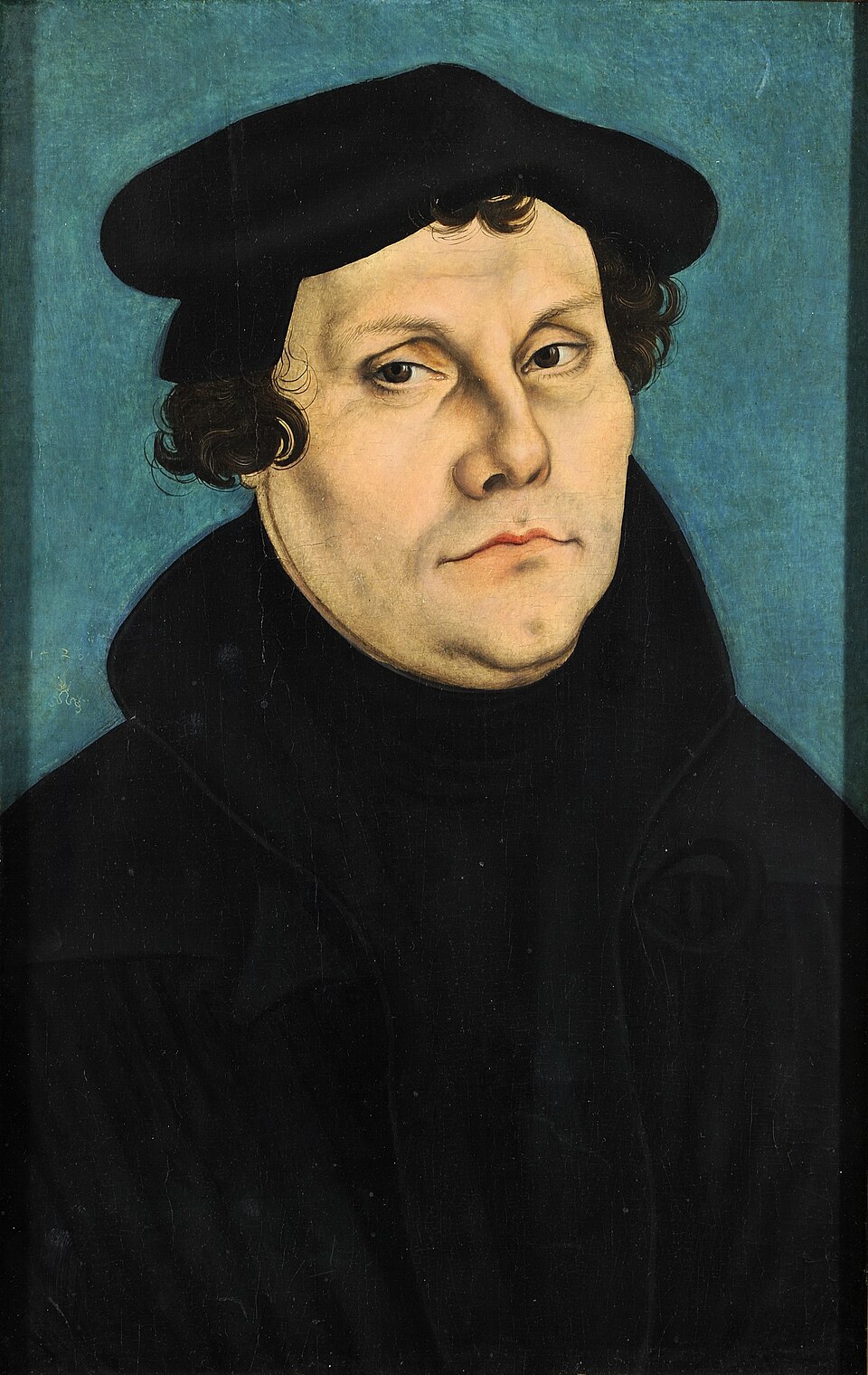
- Inline image: Lucas Cranach the Elder — Lucas Cranach the Elder, Portrait of Martin Luther, 1528, Veste Coburg. Public-domain artwork and reproduction, via Wikimedia Commons; resized for display.