
Victorian fashion: pain and respectability
A woman could be criticized for tightening her corset too much and judged insufficiently dressed without one. That contradiction makes Victorian fashion more revealing than a simple story of torture garments. Clothing shaped the body, but respectability shaped the choices available to the wearer. Physical comfort was negotiated alongside appearance, money, and the risk of public disapproval.[1][2]
The discussion here centers on nineteenth-century British fashion and its connected European and American debates. There was no single garment, degree of tightness, or experience shared by every woman. Museum collections show changing constructions and silhouettes. They also warn against confusing the most extreme examples with ordinary practice.[2][3]
A respectable body had to look managed
The Lady’s Dressing Room, published in English in 1893, offers a striking example of the double demand. Baroness Staffe’s advice condemns excessive compression yet insists that some women cannot look properly dressed without a corset. It praises support, grace, and cleanliness while describing the female figure as frail. This is prescriptive writing: evidence of what an adviser wanted women to do, rather than proof that every reader complied.[1]
The language turns an object into a judgment about its owner. A badly kept corset signals carelessness; an unsupported figure becomes a failure of presentation. The implication is that dressing acceptably involved maintaining both a garment and a social reputation. Moral discipline and visual polish became difficult to separate, even when the advice itself recognized discomfort.[1]
This did not mean that respectability simply demanded the greatest possible bodily concealment. Museum accounts treat the corset as an object with erotic as well as disciplinary meanings. A shaped waist and bust could make a woman visibly feminine, while critics condemned an excessive pursuit of that same ideal. Fashion and moral judgment worked together, but never formed a perfectly consistent set of rules.[2][4]
What can we actually say about pain?
Tightlacing could be uncomfortable, and contemporary advice described pressure and difficulty breathing. Such complaints should be taken seriously as historical testimony. They do not establish how often every wearer suffered, or prove every disease that campaigners attributed to corsets. Garment fit, construction, adjustment, and the activity being attempted all matter when interpreting accounts of bodily restriction.[1][2]
The Museum at FIT challenges the familiar image of universal eighteen-inch waists. Surviving garments and advertisements show a wider range of sizes, and laces could leave room at the back. A small dress measurement alone does not tell us how much its owner reduced her waist. Some women sought a pronounced fashionable shape; wearing a corset and practicing extreme tightlacing were not identical behaviors.[2]
Bioarchaeologist Rebecca Gibson’s research adds another caution. Her work investigates skeletal changes associated with corseting, but her 2023 article also challenges two influential radiographs published in Ludovic O’Followell’s 1908 Le Corset, arguing that they were manipulated. Those images are later than Victoria’s reign and cannot be treated as straightforward photographs of what Victorian corsets did to all bodies. A dramatic medical illustration is evidence to examine, not a diagnosis to copy.[5][6]
Gibson also argues that criticism of corsets could express hostility to female autonomy. That does not make every garment comfortable or every complaint false. It means that doctors and reformers, like fashion writers, had assumptions about how women should live. Our interpretation must allow both bodily constraint and the possibility that a wearer valued support, appearance, or self-expression.[4][5]
The skirt mattered as much as the waist
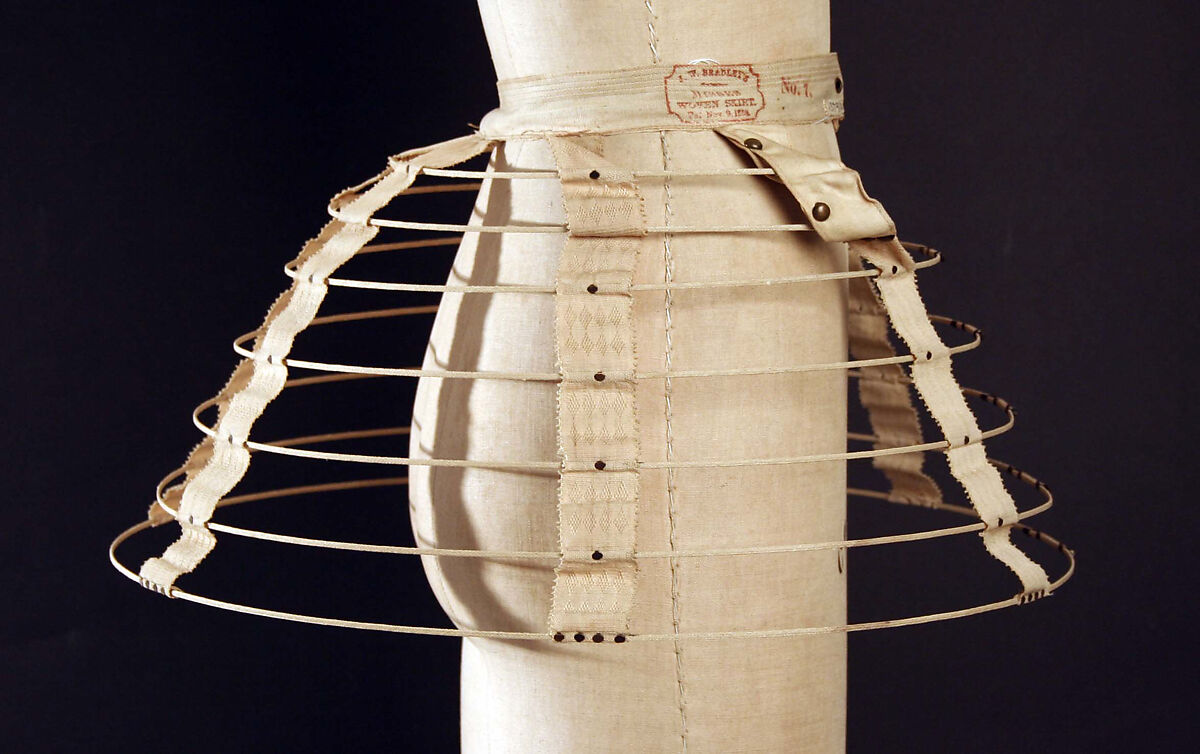
Heavy, hot petticoats supported wide skirts. In 1856, the steel cage crinoline offered a lighter alternative. Its width created different problems: awkward movement through narrow spaces and the danger of expansive flammable skirts near open fires. An innovation could relieve one difficulty while introducing another.[3]
Later bustles supported fabric behind the body; some designs combined with narrow overskirts restricted walking and sitting. Corsets, crinolines, and bustles imposed different demands, rather than forming one unchanging Victorian outfit.[3]
| Garment or practice | Possible physical burden | What we should not assume |
|---|---|---|
| Tightlacing | Compression and discomfort. | Not equivalent to all corset use. |
| Layered petticoats | Weight and heat. | Unhooped did not necessarily mean comfortable. |
| Cage crinoline | Width and fire hazards. | Often lighter than many petticoats. |
| Bustle and narrow overskirt | Restricted movement and sitting. | Extreme caricatures were not representative. |
An industry could sell conformity—and reform
Industrial production broadened the market for fashionable underwear. FIT notes that nineteenth-century innovations made corsets accessible to a much wider range of women. The V&A describes sewing-machine production of affordable cage crinolines. These were material systems as well as aesthetic preferences: manufacturing helped spread a silhouette, while the expectation of a particular silhouette helped sustain demand.[2][3]
Alternative styles also entered the marketplace. The V&A’s account of Arts and Crafts fashion describes looser garments shaped by an interest in historical dress and greater bodily freedom. A different cultural ideal could therefore generate different products. Buying an alternative was one way to act on criticism, though the existence of an alternative did not guarantee its social acceptance.[7]
Comfort could carry a social price
The American bloomer controversy makes that price explicit. Amelia Bloomer promoted trousers beneath a shorter skirt in 1851. Reformers argued that this reduced cumbersome fabric and improved freedom of movement. The National Archives describes critics accusing adopters of abandoning femininity and dressing as men; the National Park Service also records the ridicule. The objection reached beyond whether the clothes worked.[8][9]
These sources suggest why a more comfortable option might still be difficult to choose. A wearer could exchange physical inconvenience for public scrutiny. The economic question was not just the purchase price of fabric, and the cultural question was not just taste: both concerned the cost of being recognized as an acceptable woman.[8][9]
Victorian clothing could hurt, constrain, support, decorate, and give pleasure, sometimes in the same wardrobe. The strongest account does not require every woman to have been miserable. It asks why bodily comfort had to compete with expectations of respectable femininity—and how manufacturers, advisers, reformers, and wearers negotiated that competition.[1][4][5][7]
Sources & citations
- Baroness Staffe, The Lady’s Dressing Room, translated by Lady Colin Campbell (1893), Part II — Primary advice text. Its statements about health and women’s bodies are treated as period claims, not adopted as current medical conclusions.
- The Museum at FIT, “The Body: Fashion and Physique,” eighteenth- and nineteenth-century sections — Museum collection and exhibition interpretation covering sizes, demographic spread, lacing, and the limits of inferring tightlacing from small garments.
- Victoria and Albert Museum, “Corsets, crinolines and bustles: fashionable Victorian underwear” — Garment-based account of changing construction, petticoats, cage crinolines, mobility, and dress reform.
- The Museum at FIT, “The Corset: Fashioning the Body” — Valerie Steele’s exhibition considers the corset’s shifting meanings, including femininity, eroticism, and oppression.
- Rebecca Gibson, “Theorizing with incorrect data: A new look at the historical inaccuracies of the bioarchaeology of corsets” (2023) — American Anthropologist 125(3), 715–726. Research criticizing the reliability of influential 1908 radiographs and their subsequent interpretation.
- Rebecca Gibson, The Corseted Skeleton: A Bioarchaeology of Binding (2020) — Research on skeletal evidence from 1700–1900. Cited for the scope of the investigation; it does not supply a population-wide estimate of pain.
- Victoria and Albert Museum, “How the Arts and Crafts movement influenced fashion” — Museum account of dress reform, historical inspiration, and looser alternatives to mainstream silhouettes.
- Linda Simmons, National Archives, “Petition of Amelia Bloomer Regarding Suffrage in the West” — Historical context for dress reform, cost arguments, gender policing, and political participation; its sweeping medical characterizations are not repeated as established fact.
- National Park Service, “Bloomers on the Trail” — Independent institutional account of the 1851 dress-reform campaign, ridicule, and practical adoption.
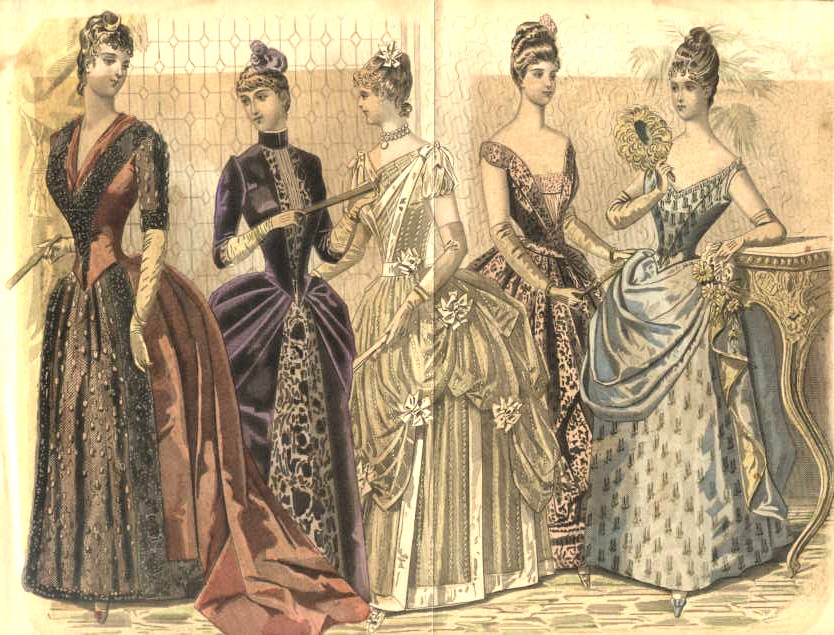
- Featured image: Peterson’s Magazine fashion plate (1888) — Fashion plate from Peterson’s Magazine, 1888. Public-domain illustration, via Wikimedia Commons. Cropped to fit the featured-image frame.
- Inline image: Maker unidentified; image The Metropolitan Museum of Art — American cage crinoline, about 1858. The Metropolitan Museum of Art, Gift of Estate of Mary Le Boutillier, 1945 (C.I.45.79.10). Public-domain image, The Met Open Access.