
Japan’s postwar electronics boom
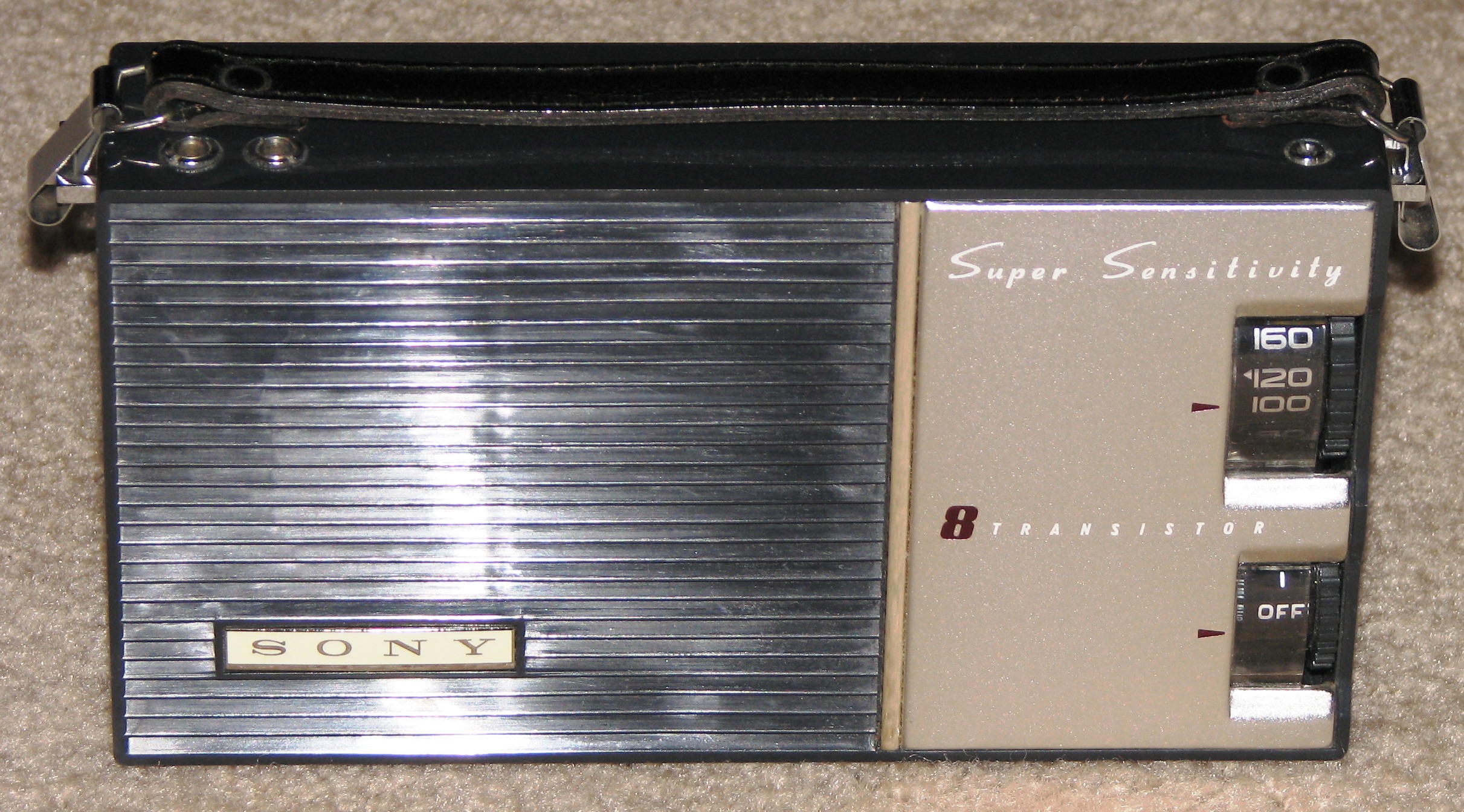
A pocket radio looks like a small object with a simple purpose. In postwar Japan, it belonged to a much larger rearrangement: engineers looking for civilian markets, an occupying power rebuilding communications, and manufacturers learning to sell abroad. World War II did not automatically create an electronics superpower. Defeat and reconstruction changed the conditions under which an existing body of technical knowledge could be used.[1][2][3]
What survived the destruction
Sony’s own history begins with a wartime meeting. Masaru Ibuka, a civilian engineer, met naval lieutenant Akio Morita through an engineering research committee in 1945. After the surrender, Ibuka established a workshop in a damaged Tokyo department store. Radio repair and modifications that enabled shortwave reception became early business. The company later known as Sony was founded as Tokyo Tsushin Kogyo in 1946.[2][4]
That account matters because it complicates the familiar story of invention beginning from nothing. People, skills, and professional relationships could survive even when buildings and institutions did not. Repairing a radio also answered a specific civilian desire: access to information. Sony’s retrospective is a company’s account of its origins, so its heroic tone deserves caution; the documented sequence is more useful than a tale of national destiny.[2][3]
Occupation made communications a priority
The American-led occupation initially pursued demilitarization and political reform. By 1947–48, economic crisis and Cold War concerns made recovery a more urgent American objective. This was a change in policy, not an uninterrupted plan to manufacture Japan’s later success. Shortages of industrial inputs and difficulty finding markets remained serious obstacles.[1]
Communications occupied a particularly important place in that reconstruction. Business historian Toshihiro Wada describes the Civil Communications Section, established within the occupation administration in October 1945, and its role in introducing quality-control practices. Reliable communications served occupation government as well as civilian needs. Engineers associated with Bell Laboratories participated in the work; Japanese ministries, firms, and professional organizations also helped develop and spread the methods.[3]
In 1950, the Union of Japanese Scientists and Engineers invited W. Edwards Deming to teach statistical quality control. JUSE’s account describes courses reaching executives, managers, engineers, and researchers; it established the Deming Prize the following year. The important shift was organizational: quality could be investigated and improved through methods shared across a business. This history gives us institutions and training to examine, rather than an explanation based on an allegedly timeless Japanese character.[3][5]
A second war accelerated recovery
The Korean War, beginning in 1950, made Japan a major supply base for United Nations forces. Procurement and repair orders helped stimulate recovery. Japan’s foreign ministry later described a sequence from this demand to investment and consumer booms. These were distinct developments: the war in Korea supplied an economic stimulus, while the electronics industry still had to turn resources and expertise into products people wanted.[1][6]
That distinction prevents a misleading moral shortcut. A later industrial achievement does not turn wartime destruction into a necessary benefit. The historical connection runs through decisions taken after catastrophe, including a changed American strategic relationship with Japan. Recovery also required access to imported resources and the export earnings to pay for them.[1][6]
Buying a patent was only the beginning
Sony pursued a Western Electric transistor license in the early 1950s. Its history describes the difficulty of securing permission and developing a workable manufacturing process. The transistor was an American invention; making it commercially useful in Japanese consumer products required further engineering. Licensing and innovation were parts of the same process, rather than opposites.[7]
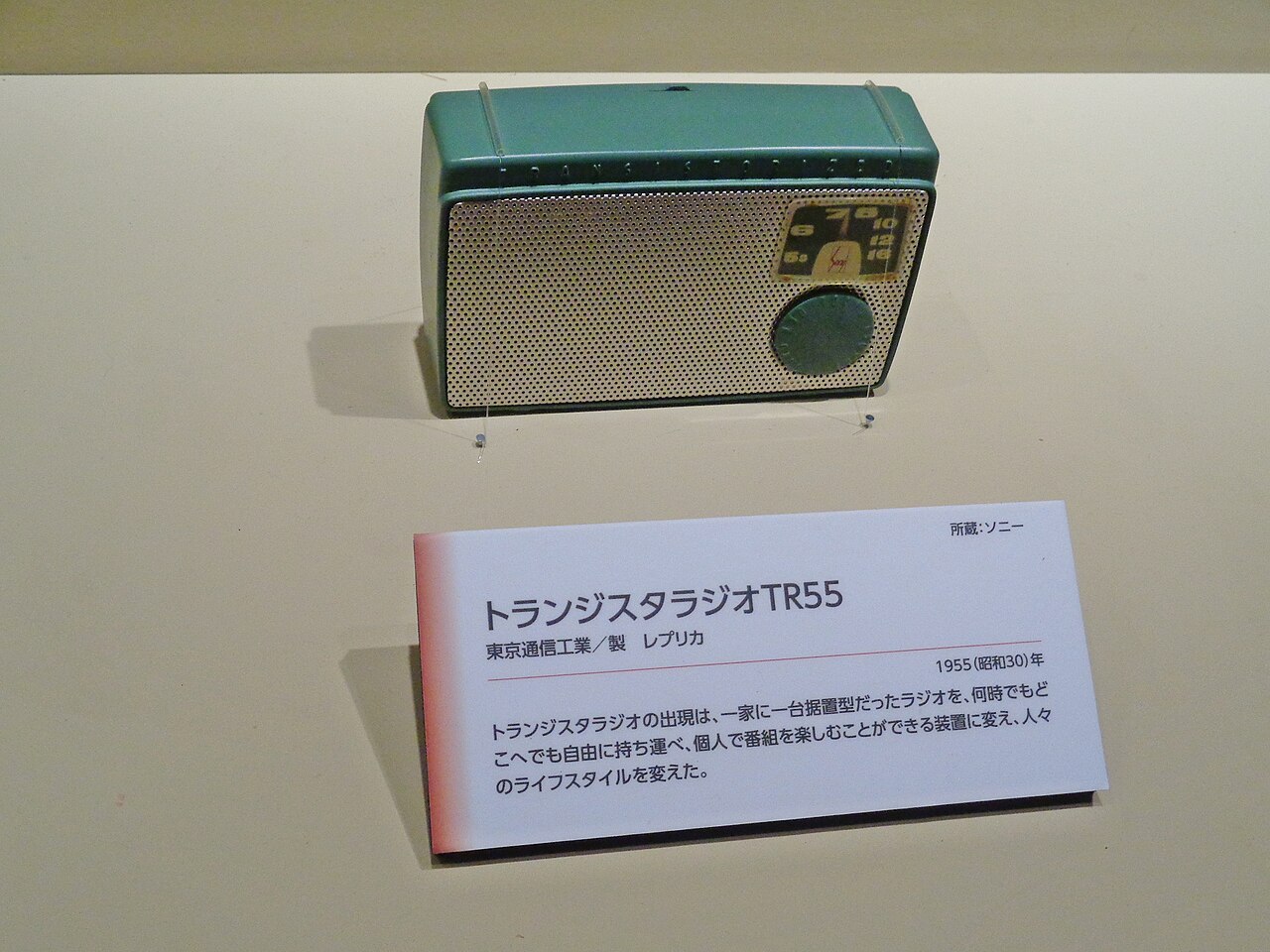
The TR-55 went on sale in 1955 as Japan’s first commercially produced transistor radio. It was not the world’s first: the American Regency TR-1 had reached the market in 1954. In 1957, Sony launched the smaller TR-63 and expanded its overseas business. The distinction between inventing a device, manufacturing it reliably, and finding a large market is essential to understanding this transformation.[4][7][8]

| Date | Development | Economic and cultural connection |
|---|---|---|
| 1945–46 | Radio repairs and the formation of Tokyo Tsushin Kogyo. | Technical skills find civilian customers. |
| 1950–51 | Deming’s JUSE courses and the establishment of the Deming Prize. | Quality improvement becomes a shared institutional project. |
| 1950 onward | Korean War procurement and repair orders. | International conflict stimulates Japanese demand and production. |
| 1955–57 | Sony’s TR-55 and TR-63. | Manufacturing and product design support personal electronics and exports. |
Consumers changed what electronics meant
At home, the broader electrical-appliance boom made a television, washing machine, and refrigerator widely recognized symbols of an improved standard of living. These appliances were not all electronics in the narrow technical sense, but they belonged to the same growing consumer economy. Panasonic’s company history describes high initial prices and expanding production that helped bring costs down. Demand was shaped by an idea of what a modern household ought to contain.[9]
Abroad, a small Japanese-made radio could enter a different cultural story. The Smithsonian describes American teenagers adopting transistor radios as prices fell and rock and roll spread in the late 1950s. Portability and an earphone offered a listening space separate from parents. Manufacturers sold a device; young listeners helped establish a social use for it. Many of the radios were imported from Japan.[10]
This is the intersection that makes the story larger than a business success. Industrial organization and international exchange helped make the products available. Household aspirations and personal listening habits gave them meaning and sustained demand. Japan’s postwar electronics transformation was built through that exchange between production and culture—not through war alone, and not through technology acting independently of its users.[3][9][10]
Sources & citations
- U.S. Department of State, Office of the Historian, “Occupation and Reconstruction of Japan, 1945–52” — Institutional historical overview of occupation policy, the reverse course, and Korean War procurement.
- Sony Group History, Volume 1, Chapter 1, “Forming Tokyo Tsushin Kogyo” — Company retrospective used for the founders, wartime meeting, and early repair business; its institutional perspective is acknowledged.
- Toshihiro Wada, “The Introduction and Development of Quality Control in the Communication Equipment Industry, 1945–1955” (1996) — Japanese Yearbook on Business History 12, 73–98. Research on occupation communications, technical personnel, and quality control.
- Sony Group, Corporate History — Company chronology used to check the 1946 foundation and 1955 TR-55 launch.
- Union of Japanese Scientists and Engineers, “How was the Deming Prize Established” — Institutional account of the 1950 teaching visit and 1951 prize.
- Ministry of Foreign Affairs of Japan, Diplomatic Bluebook 1985, “External Economic Relations” — Government retrospective on procurement, investment, consumption, and foreign trade; not an estimate of a single electronics growth effect.
- Sony Group History, Volume 1, Chapter 3, “Developing the Transistor Radio” — Company account of licensing, development, TR-55, and TR-63 exports. Promotional superlatives are not adopted here.
- Computer History Museum, “1952: Transistorized Consumer Products Appear” — Used for the Regency TR-1’s 1954 introduction, independently distinguishing it from Sony’s later Japanese first.
- Panasonic Group History, “1956: Beginning of the home appliance era” — Company history of appliance demand, prices, and production. The article distinguishes electrical appliances from electronics narrowly defined.
- Smithsonian National Museum of American History, “It’s personal!” — Museum interpretation of transistor radios, Japanese imports, American teenage listening, and portability.
- Featured image: Joe Haupt — Sony TR-84 eight-transistor AM radio, made in Japan, circa 1960. Photograph by Joe Haupt, via Wikimedia Commons, CC BY-SA 2.0. Cropped to fit the featured-image frame.
- Joe Haupt, original Sony TR-84 photograph and updated description — The photographer’s updated dating is circa 1960; the Commons copy retains an older 1959 description.
- Inline image: ブルーノ・プラス — A display replica of the TR-55 transistor radio introduced in 1955; the exhibition label identifies this example as a replica. Photograph by ブルーノ・プラス, March 2018, CC0.